
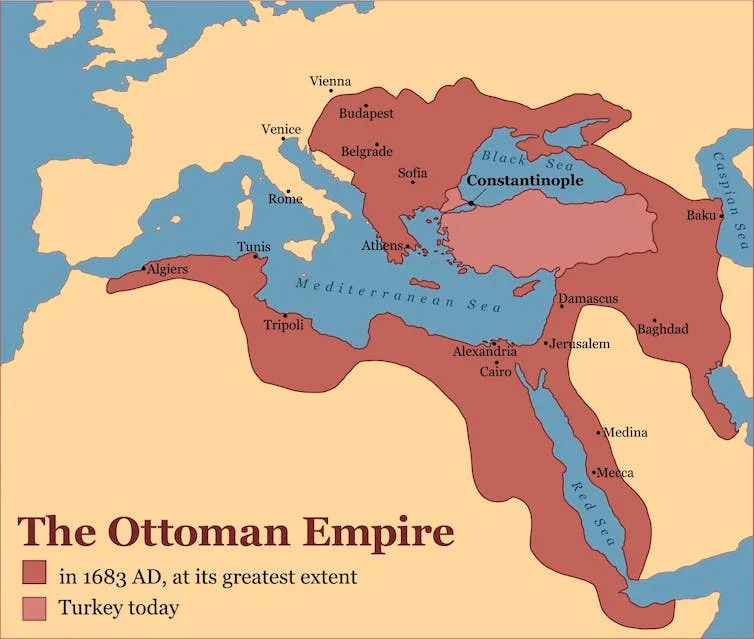
Have you ever wondered which countries were once part of the vast Ottoman Empire? Understanding this can give you a fresh perspective on history, culture, and how many modern nations came to be.
If you’re curious about the lands that were connected under one powerful empire, this article will guide you through the key regions and countries that made up the Ottoman Empire. Keep reading to discover surprising facts that might change the way you see history—and your own place in it.
Origins Of The Ottoman Empire
The Origins of the Ottoman Empire trace back to the late 13th century, beginning with a small Turkish principality in Anatolia. This empire started as a modest frontier state but grew into one of history’s most powerful empires. Understanding its roots helps you appreciate how ambition and strategy can transform a humble beginning into a vast empire.
The Early Turkish Principalities
The Ottoman Empire began as one of many small Turkish principalities that emerged after the decline of the Seljuk Sultanate of Rum. These principalities were often in constant conflict, seeking control over trade routes and territory.
Osman I, the empire’s founder, led his principality with strong leadership and military skill. His success in expanding territory laid the foundation for what would become the Ottoman Empire.
The Role Of Geography
Anatolia’s location was crucial to the empire’s rise. Positioned between Asia and Europe, it served as a bridge for trade, culture, and military campaigns.
The natural terrain provided defensive advantages and access to vital trade routes. This geographical position helped the Ottomans control critical passageways and grow their influence.
Influence Of The Byzantine Empire
The weakening Byzantine Empire created opportunities for the Ottomans to expand. They gradually took over Byzantine territories, including key cities like Bursa and later Constantinople.
This expansion was not just military but also political, as the Ottomans adopted administrative systems and cultural elements from the Byzantines. How do you think adapting from others’ strengths can help in your own growth?
Religious And Cultural Foundations
The Ottoman Empire was rooted in Islamic culture but was also known for its tolerance towards different religions and ethnicities. This diversity helped maintain stability across vast regions.
The empire’s ability to manage various cultures under one rule was key to its endurance. Imagine managing your team by respecting their unique backgrounds—this approach can foster loyalty and success.
Expansion Into Europe
The Ottoman Empire’s expansion into Europe marked a significant chapter in world history. This movement reshaped borders and cultures, influencing the political landscape for centuries. Understanding where and how the Ottomans extended their reach helps you grasp the empire’s lasting impact on European history.
Balkans And Southeast Europe
The Ottomans first entered Europe through the Balkans in the late 14th century. They captured key territories like Bulgaria, Serbia, and Bosnia, which became important parts of the empire. These areas served as a gateway for further expansion and military campaigns.
Living in the Balkans today, you might notice Ottoman influences in architecture, cuisine, and traditions. This blend of cultures shows how deeply the empire’s presence affected everyday life. Have you ever wondered how historical empires shape modern identities?
Impact On Central Europe
Central Europe faced constant pressure from Ottoman advances, especially in Hungary and Austria. The Battle of Mohács in 1526 was a turning point, leading to Ottoman control over much of Hungary. This challenged European powers to rethink their strategies and alliances.
The Ottomans introduced new administrative systems and trade routes that altered Central Europe’s economy. If you study European history, you’ll see how this period forced regions to adapt quickly. How might your own region respond if faced with such rapid change?
Territories In The Middle East
The Ottoman Empire’s reach in the Middle East was vast and complex, covering diverse landscapes and cultures. Understanding these territories helps you appreciate how the empire managed such a vast and varied region. Let’s break down the key areas within the Middle East that the Ottomans controlled.
Levant Region
The Levant was a crucial part of the Ottoman Empire, including modern-day countries like Syria, Lebanon, Israel, Palestine, and Jordan.
This area was a crossroads of cultures, religions, and trade routes, making it vital for the empire’s economy and politics.
Imagine the challenge of governing cities like Damascus and Jerusalem, each with its unique identity and importance. The Ottomans often balanced local autonomy with central control to keep peace and order here.
Arabian Peninsula
The Arabian Peninsula under Ottoman control included parts of today’s Saudi Arabia, Yemen, and the Gulf states.
This region was less densely populated but held strategic religious sites like Mecca and Medina, which gave the empire significant religious authority.
Managing the desert tribes and maintaining control over the pilgrimage routes required the Ottomans to adapt their military and administrative strategies.
Have you ever considered how controlling such a vast and challenging terrain shaped the empire’s policies and military tactics?
North African Holdings
The Ottoman Empire’s reach in North Africa was vast and influential, shaping the region’s culture, politics, and trade for centuries. These North African holdings connected Africa to the Mediterranean and the Middle East, creating a bridge for goods and ideas. Understanding these territories gives you a clearer picture of how the empire managed such a diverse and sprawling domain.
Egypt And Surrounding Areas
Egypt was the crown jewel of the Ottoman Empire’s North African territories. It served as a strategic hub, linking Africa with the Mediterranean Sea and the Red Sea trade routes. The Ottomans ruled Egypt through local governors called pashas, who balanced Ottoman control with local customs.
Beyond Egypt, the empire controlled parts of modern-day Sudan and Libya. These areas were crucial for securing trade routes and resources. Have you ever wondered how controlling the Nile River influenced the empire’s power? The Ottomans knew its importance well.
Maghreb Region
The Maghreb includes present-day Algeria, Tunisia, and Morocco. The Ottomans held significant influence in Algeria and Tunisia but never fully controlled Morocco. This region was vital for Mediterranean trade and military defense.
In cities like Algiers and Tunis, Ottoman rulers established strong naval bases to protect their interests. Their presence here helped curb European expansion for a time. What challenges do you think the Ottomans faced trying to govern such diverse and distant territories?
Control Over Anatolia And Asia Minor
The Ottoman Empire’s control over Anatolia and Asia Minor was the foundation of its vast power. This region, rich in culture and resources, served as the empire’s heartland. The Ottomans began as a small principality here before expanding their rule.
Anatolia’s strategic location connected Europe and Asia. It allowed the Ottomans to control key trade routes. This control helped them grow economically and militarily. The empire built strong cities and fortresses to maintain their hold.
The diverse population of Anatolia included Turks, Greeks, Armenians, and Kurds. The Ottomans managed these groups through a flexible system. This system allowed local customs and religions to continue under Ottoman rule.
Geographical Significance Of Anatolia And Asia Minor
Anatolia is a large peninsula in modern-day Turkey. It lies between the Black Sea and the Mediterranean Sea. Asia Minor is another name for this region. Its location made it a crossroads of different civilizations.
Control of Anatolia meant control of important land routes. These routes connected the Middle East to Europe. The Ottomans used these paths to move troops and goods efficiently. This helped them defend and expand their empire.
Early Ottoman Expansion In Anatolia
The Ottoman state started in northwestern Anatolia in the late 13th century. They grew by conquering neighboring Turkish beyliks (small states). This unification created a strong base for further expansion.
The Battle of Bapheus in 1302 was a key victory. It allowed the Ottomans to dominate much of western Anatolia. From there, they pushed deeper into Asia Minor and beyond.
Administration And Cultural Integration
The Ottomans used a system called the millet to govern diverse groups. This system let communities keep their religion and laws. It helped maintain peace and loyalty in Anatolia.
The empire also promoted Turkish language and culture. Yet, it respected local traditions and religions. This balance helped the Ottomans keep control over Asia Minor for centuries.

Credit: owlcation.com
Key Cities And Strategic Locations
The Ottoman Empire, with its vast expanse across Europe, Asia, and Africa, was not just defined by its borders but by the strategic cities that served as its backbone. These key cities were not just political capitals but also hubs of trade, culture, and religion. Understanding these locations gives insight into the empire’s lasting impact and its legacy that shaped the modern world. Let’s explore some of these pivotal cities and their significance.
Istanbul As The Capital
Istanbul, formerly known as Constantinople, was the vibrant heart of the Ottoman Empire. Sitting at the crossroads of Europe and Asia, it was uniquely positioned as a bridge between continents. This strategic location made it a crucial center for trade, facilitating the exchange of goods and ideas from across the world.
Walking through Istanbul today, you can still feel the echoes of its rich history. The architectural marvels like the Hagia Sophia and the Topkapi Palace whisper tales of the empire’s grandeur. Have you ever imagined what it was like to live in a city that was the epicenter of an empire? It’s fascinating to think about the cultural melting pot that Istanbul was and still is today.
Other Important Urban Centers
Beyond Istanbul, the Ottoman Empire boasted several other key cities that played crucial roles. Cairo, for example, was not only a vital trade hub but also a center of learning and Islamic scholarship. The bustling markets of Cairo were famous for their diversity and vibrancy, offering everything from spices to textiles.
Another significant city was Damascus, known for its beautiful crafts and rich history as one of the oldest continuously inhabited cities in the world. Imagine wandering through its ancient streets, where every corner tells a story of its past. How did these cities contribute to the empire’s influence, and what lessons do they hold for us today?
These urban centers were more than just cities; they were the lifeblood of the Ottoman Empire, each contributing its unique flavor to the empire’s vast mosaic. Their stories are a testament to the empire’s ability to adapt and thrive in various cultural and geographical landscapes.
Legacy Of Ottoman Borders Today
The borders once ruled by the Ottoman Empire continue to shape the world today. These boundaries influenced not only the map but also the culture and politics of several modern nations. Understanding this legacy helps you grasp why certain regions share deep historical connections and ongoing challenges.
Modern Countries Formed
The Ottoman Empire stretched across parts of Europe, Asia, and Africa. Today, many countries stand where its provinces once existed.
- Turkey, the heart of the empire, rose from its core.
- Balkan nations like Greece, Bulgaria, and Serbia gained independence but retain Ottoman-era influences.
- Middle Eastern countries such as Syria, Iraq, Lebanon, and Palestine emerged from former Ottoman territories.
- North African states including Egypt, Libya, and Tunisia trace some borders back to Ottoman times.
Have you ever noticed how borders in these regions sometimes feel arbitrary? This reflects decisions made during and after the empire’s fall, showing that history deeply impacts your current geopolitical landscape.
Cultural And Political Influence
The Ottoman Empire left a lasting cultural imprint that you can still see today. Architecture, cuisine, language, and traditions often blend Ottoman elements with local customs.
Politically, many countries inherited systems shaped by Ottoman governance. Some legal codes and administrative practices have roots in Ottoman rule, affecting how governments operate now.
Consider how shared history influences diplomatic relations. Countries with Ottoman heritage sometimes find common ground or face tensions linked to their pasts.
When you explore a city like Istanbul or Beirut, you witness living history. Ottoman legacies are not just in books but woven into everyday life, reminding you that borders are more than lines—they are stories.

Credit: seunonigbinde.medium.com

Credit: www.reddit.com
Frequently Asked Questions
What Modern Countries Were Part Of The Ottoman Empire?
The Ottoman Empire included parts of Turkey, Greece, Bulgaria, Egypt, Syria, Iraq, and more. It spanned Southeast Europe, Western Asia, and North Africa.
When Did The Ottoman Empire Control These Countries?
The empire existed from 1299 to 1922. It reached its peak in the 16th and 17th centuries, controlling vast territories.
How Did The Ottoman Empire Influence These Regions?
The empire shaped culture, architecture, language, and governance in its territories. Its legacy remains visible in cuisine, art, and legal systems.
Why Did The Ottoman Empire Decline And Lose Countries?
Internal conflicts, military defeats, and rising nationalism weakened the empire. World War I further accelerated its collapse and territorial loss.
Conclusion
The Ottoman Empire covered many lands across Europe, Asia, and Africa. It shaped cultures, trade, and history in these regions. Today, the countries that once belonged to it have unique stories and traditions. Understanding this empire helps us learn about the past and its impact on the present.
The legacy of the Ottoman Empire still influences many parts of the world today. History connects us all.



