
Have you ever wondered about the deep roots of Turkey and its connection to one of history’s most powerful empires? Understanding whether Turkey was part of the Ottoman Empire can change the way you see its culture, history, and even its role in the world today.
If you want to uncover the truth behind this fascinating link and discover how it shapes modern Turkey, keep reading. This article will give you clear answers and surprising facts that will make you see Turkey in a whole new light.

Credit: en.wikipedia.org
Origins Of The Ottoman Empire
The origins of the Ottoman Empire trace back to the late 13th century in Anatolia. This empire began as a small Turkish principality. It grew steadily through strategic leadership and military strength. The foundation set the stage for one of history’s longest-lasting empires. Understanding its origins helps reveal how modern Turkey connects to this vast empire.
Rise Of The Ottoman Dynasty
The Ottoman dynasty started with Osman I around 1299. Osman led a group of Turkish tribes in northwest Anatolia. He united these tribes under his rule, forming the core of the empire. The name “Ottoman” comes from Osman’s name in Arabic, Uthman.
Osman’s leadership focused on building a strong, loyal community. He used smart diplomacy and military skill to expand influence. His successors continued this work, strengthening the dynasty’s power.
Early Expansion And Conquests
The early Ottomans expanded into Byzantine lands near their base. They captured key towns and fortresses to control trade routes. The empire grew slowly but steadily.
Conquests included:
- Bursa, captured in 1326, became the first capital
- Gallipoli, seized in 1354, secured a European foothold
- Constantinople, conquered in 1453, marked the empire’s rise as a major power
These early victories gave the Ottomans access to important resources. They built a strong military and government system. This foundation enabled centuries of growth and influence.
Territorial Reach Of The Empire
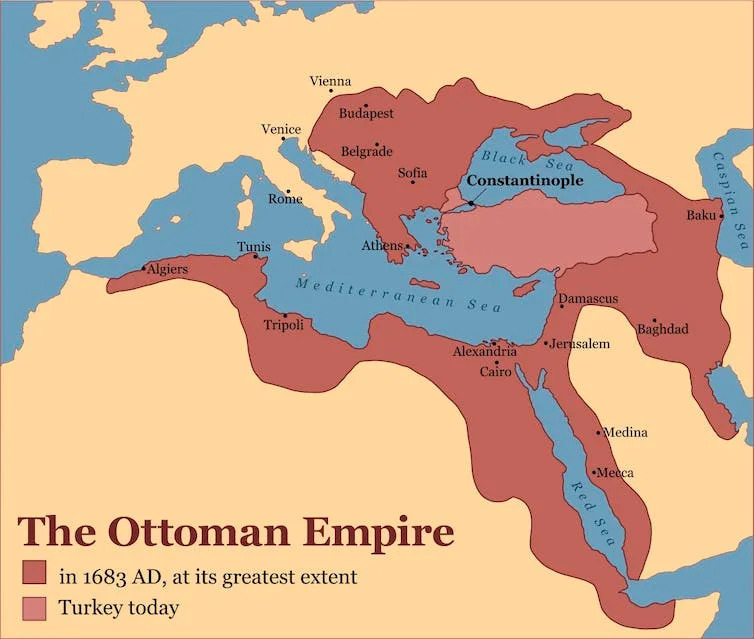
The Ottoman Empire was one of history’s largest and longest-lasting empires. Its territorial reach spread across continents and cultures. Understanding its geography helps us see why Turkey was central to this vast empire. The empire’s lands covered critical regions that shaped its power and legacy.
Core Regions And Provinces
The heart of the Ottoman Empire was in modern-day Turkey. Key provinces included:
- Anatolia, the Asian part of Turkey, served as the empire’s base.
- Rumelia, the European lands of the empire, covered the Balkans.
- Mesopotamia and parts of the Middle East expanded its control further east.
- North Africa, including Egypt and Libya, stretched its influence southward.
These core regions kept the empire strong for centuries.
Influence Over Anatolia And Beyond
Anatolia was the empire’s cultural and political center. The Ottomans built cities, mosques, and trade routes here. The region’s location connected Asia and Europe. This gave the empire control over important trade paths.
The empire also reached far beyond Anatolia. It ruled large parts of the Balkans and the Middle East. This wide influence helped spread Ottoman culture and law. It also made the empire a key player in global politics.
Anatolia’s Role In The Empire
Anatolia was the heartland of the Ottoman Empire, providing key resources and strategic locations. This region played a vital role in the empire’s growth and control. Turkey, largely overlapping with Anatolia, was indeed part of the Ottoman Empire for centuries.
Anatolia, often referred to as Asia Minor, was a vital region in the Ottoman Empire. Its strategic location and rich cultural history made it a cornerstone for imperial power and influence. The significance of Anatolia can be seen in its geographic, cultural, and political contributions to the Ottoman legacy.Geographic Importance
Anatolia’s location served as a bridge between Europe and Asia. This unique position enabled the Ottomans to control key trade routes. It also acted as a buffer zone against potential invasions from the east and west. The rugged terrain of Anatolia provided natural fortifications. This made it easier for the Ottomans to defend their empire. Additionally, the fertile lands supported agriculture, bolstering the empire’s economy. Have you ever thought about how geography can shape a nation’s destiny? Anatolia’s landscape is a perfect example of this. It was not just a piece of land but a strategic asset that shaped the empire’s fortunes.Cultural And Political Integration
Anatolia was a melting pot of cultures long before the Ottomans arrived. This diversity enriched the Ottoman Empire, fostering a unique blend of traditions and practices. The Ottomans embraced this diversity, integrating it into their governance and society. The political integration of Anatolia was seamless. The Ottomans respected local traditions while establishing their rule. This approach ensured loyalty and stability within the region. Consider how inclusivity can lead to stronger governance. The Ottomans’ integration of Anatolia shows that embracing diversity can fortify an empire. It wasn’t just about control but about uniting different cultures under a common banner. In Anatolia, the Ottomans found not just land, but a vibrant community. This community became a backbone for the empire, proving that strategic alliances are often found in understanding and respecting diversity.
Credit: jonathanrileywriter.medium.com
Transition From Empire To Modern Turkey
The transition from the Ottoman Empire to modern Turkey marks a major change in history. This period shows the shift from a vast empire to a new, republic-based nation. It involved wars, reforms, and new ideas. The transformation shaped the Turkey we know today.
Fall Of The Ottoman Empire
The Ottoman Empire lasted over 600 years but faced many challenges in the 19th and 20th centuries. It lost lands in wars and faced internal problems. World War I was a major blow. The empire sided with the Central Powers and lost. This led to its collapse.
By 1922, the empire officially ended. The sultanate was abolished. Many regions declared independence or joined other countries. The once-powerful empire was no more.
Birth Of The Republic Of Turkey
After the empire fell, a new leader emerged: Mustafa Kemal Atatürk. He led the Turkish War of Independence. Atatürk wanted a modern, secular nation. The Republic of Turkey was founded in 1923.
The new republic introduced reforms in law, education, and culture. It replaced the old imperial system with a democratic government. This new Turkey focused on unity and progress.
Legacy Of The Ottoman Empire In Turkey
The legacy of the Ottoman Empire in Turkey is visible everywhere you look. It shapes the country’s identity, from its buildings to its everyday life. Understanding this legacy helps you see how history continues to influence modern Turkey.
Architectural Heritage
The Ottoman Empire left behind stunning architecture that still stands strong. Mosques like the Sultan Ahmed Mosque, also known as the Blue Mosque, showcase intricate designs and grand domes. These buildings are not only places of worship but also symbols of artistic achievement.
When you walk through Istanbul, you can spot Ottoman palaces, bridges, and bazaars that tell stories from centuries ago. The use of tiles, calligraphy, and spacious courtyards invites you to appreciate their craftsmanship. Have you ever noticed how these structures blend function with beauty so seamlessly?
Cultural And Social Influences
Ottoman culture shaped many aspects of daily life in Turkey. The empire’s diverse population introduced a mix of languages, cuisines, and traditions that still thrive today. Turkish coffee, for example, has roots in Ottoman times and remains a social ritual.
Social customs such as hospitality and respect for elders also carry Ottoman influences. These values create a warm and welcoming atmosphere you can feel when visiting Turkish homes or markets. How might your own social habits be influenced by this rich cultural background?

Credit: en.wikipedia.org
Frequently Asked Questions
Was Turkey Part Of The Ottoman Empire?
Yes, Turkey was the core region of the Ottoman Empire. The empire originated in Anatolia, modern-day Turkey, in the late 13th century. Istanbul, formerly Constantinople, became its capital after 1453. The empire lasted until 1922 when the Republic of Turkey was established.
When Did The Ottoman Empire Rule Turkey?
The Ottoman Empire ruled the area of modern Turkey from 1299 to 1922. It began as a small principality in Anatolia. Over centuries, it expanded across three continents. The empire officially ended after World War I, leading to the formation of modern Turkey.
How Did Turkey Emerge From The Ottoman Empire?
Turkey emerged after the Ottoman Empire’s collapse in 1922. Mustafa Kemal Atatürk led the Turkish War of Independence. He abolished the sultanate and founded the Republic of Turkey in 1923. This marked Turkey’s transition from empire to modern nation-state.
What Was Istanbul’s Role In The Ottoman Empire?
Istanbul was the capital of the Ottoman Empire from 1453. It was a major political, economic, and cultural center. The city connected Europe and Asia, boosting trade and influence. Istanbul remained key until the empire’s dissolution in 1922.
Conclusion
Turkey was once the heart of the Ottoman Empire. This empire shaped much of Turkey’s history and culture. Knowing this helps us understand Turkey today. The Ottoman Empire lasted for centuries, leaving many marks. Turkey’s identity grew from this rich past.
History connects us to places and people. The story of Turkey and the empire is clear. It shows how the past shapes the present. A simple fact: Turkey was part of the Ottoman Empire.



