
Are you curious about how your lungs work during each breath? Understanding how to calculate alveolar minute ventilation is key to unlocking insights about your respiratory health.
This simple yet powerful calculation reveals how much fresh air actually reaches your lungs every minute, helping you grasp the real efficiency of your breathing. Whether you’re a student, a healthcare professional, or just someone interested in your body, learning this will give you a clear picture of how well your lungs are performing.
Keep reading, and you’ll discover easy steps to master this important calculation and why it matters for your overall well-being.

Credit: www.youtube.com
Basics Of Alveolar Ventilation
Understanding the basics of alveolar ventilation is key to grasping how your lungs efficiently exchange gases. It’s not just about how much air you breathe in a minute, but how much actually reaches the parts of your lungs where oxygen and carbon dioxide swap places. This distinction can impact everything from athletic performance to managing respiratory conditions.
What Is Alveolar Ventilation
Alveolar ventilation refers to the volume of air that reaches the alveoli, the tiny air sacs in your lungs where gas exchange happens. This air is fresh and rich in oxygen, ready to enter your bloodstream. Not all the air you breathe in makes it this far because some remains in the dead space of your respiratory tract.
Think about it like filling a bucket with water. The bucket represents your alveoli, and the water is the oxygen-rich air. If some water leaks out before filling the bucket, you’re not getting the full benefit. That “leak” is the air trapped in dead space that doesn’t contribute to oxygen exchange.
Difference Between Minute And Alveolar Ventilation
Minute ventilation is the total volume of air you breathe in and out each minute. It combines both the air that reaches the alveoli and the air that stays in the dead space. In contrast, alveolar ventilation only counts the air that actually participates in gas exchange.
| Ventilation Type | Definition | Importance |
|---|---|---|
| Minute Ventilation | Total air moved in/out of lungs per minute | Shows breathing rate and depth |
| Alveolar Ventilation | Air reaching alveoli for gas exchange | Reflects effective oxygen delivery |
Why does this matter to you? If you focus solely on increasing your breathing rate without considering alveolar ventilation, you might not improve your oxygen intake effectively. It’s like running faster but taking shallow breaths—you’re moving air but not necessarily supplying oxygen where it counts.
Key Terms And Variables
Understanding how to calculate alveolar minute ventilation starts with getting clear on the key terms and variables involved. These elements build the foundation for accurate calculation and help you grasp how your lungs work during breathing. Let’s break down each one so you feel confident applying them.
Tidal Volume
Tidal volume is the amount of air you breathe in or out during a normal breath. It’s usually measured in milliliters (mL). Imagine taking a calm, relaxed breath—what you inhale or exhale in that moment is your tidal volume.
Knowing your tidal volume is crucial because it represents the air actually moving through your lungs with each breath. If you want to improve your breathing efficiency, start by paying attention to how much air you’re moving in each breath.
Dead Space Volume
Dead space volume refers to the portion of each breath that doesn’t participate in gas exchange. This air stays in your airways, like the trachea and bronchi, and doesn’t reach the alveoli where oxygen and carbon dioxide transfer happens.
It might surprise you that a part of every breath is essentially “wasted” air. Understanding dead space helps you realize why not all the air you breathe actually contributes to oxygenating your blood.
Respiratory Rate
Respiratory rate is simply how many breaths you take per minute. You can easily measure this by counting your breaths over 60 seconds. This number varies with activity, stress, and health conditions.
Knowing your respiratory rate gives you insight into how hard your body is working to get oxygen. Combined with tidal volume and dead space, it completes the picture needed to calculate alveolar ventilation accurately.
The Calculation Formula
The calculation formula for alveolar minute ventilation helps measure the actual air reaching the lungs’ gas exchange areas. It is essential to understand this formula to assess breathing efficiency. This formula subtracts dead space ventilation from total ventilation. The result shows the volume of fresh air available for oxygen and carbon dioxide exchange each minute.
Formula Breakdown
The formula is:
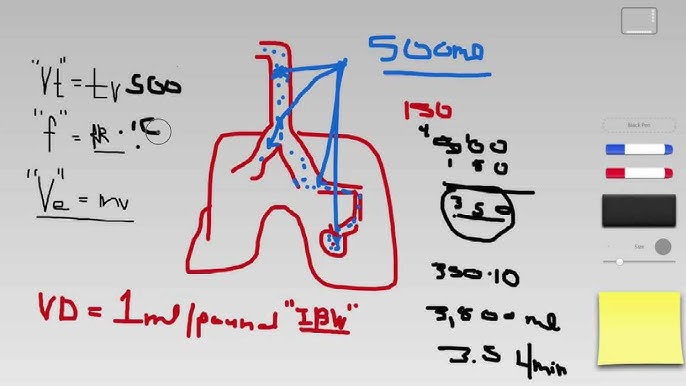
Alveolar Minute Ventilation (V̇A) = (Tidal Volume – Dead Space) × Respiratory Rate
- Tidal Volume (VT):The amount of air inhaled or exhaled per breath.
- Dead Space (VD):Air that does not participate in gas exchange, found in the airways.
- Respiratory Rate (RR):Number of breaths taken in one minute.
Subtracting dead space from tidal volume gives the air volume that reaches the alveoli. Multiplying by respiratory rate gives the total alveolar ventilation per minute.
Units And Measurements
Use consistent units for accurate results. Tidal volume and dead space are measured in milliliters (mL) or liters (L). Respiratory rate is counted in breaths per minute (breaths/min).
Commonly, tidal volume and dead space are in milliliters. Convert to liters if needed to keep units consistent.
Example:
| Variable | Unit |
|---|---|
| Tidal Volume (VT) | mL or L |
| Dead Space (VD) | mL or L |
| Respiratory Rate (RR) | breaths/min |
| Alveolar Minute Ventilation (V̇A) | L/min |

Credit: www.osmosis.org
Step-by-step Calculation
Calculating alveolar minute ventilation helps you understand how much fresh air reaches the lungs per minute. This measurement is crucial for assessing effective breathing and respiratory health. Breaking down the calculation into clear parts makes it easier to handle and apply in real situations.
Measuring Tidal Volume
Tidal volume is the amount of air you breathe in or out with each breath. You can measure this using a spirometer or estimate it based on typical values—usually around 500 milliliters for an average adult. Knowing your tidal volume gives you the base number for further calculations.
Determining Dead Space
Dead space is the portion of each breath that does not participate in gas exchange. It includes air in the nose, trachea, and bronchi. Typically, this volume is about 150 milliliters for adults, but it varies with body size and lung health.
Applying Respiratory Rate
Respiratory rate is how many breaths you take per minute. This is simple to count—just monitor your chest rises over 60 seconds. This number directly influences how much air moves in and out of your lungs every minute.
Putting It All Together
Now, subtract the dead space volume from the tidal volume to find the volume of air reaching the alveoli each breath:
| Calculation | Explanation |
|---|---|
| Alveolar Volume (ml)= Tidal Volume (ml) – Dead Space (ml) | Volume of air available for gas exchange per breath |
Next, multiply this alveolar volume by your respiratory rate:
| Calculation | Explanation |
|---|---|
| Alveolar Minute Ventilation (ml/min)= Alveolar Volume (ml) × Respiratory Rate (breaths/min) | Total air reaching alveoli per minute |
Think about your own breathing—do you notice changes during exercise or stress? How does that affect your alveolar ventilation? Tracking these numbers can give you insight into your lung efficiency and overall respiratory health.
Common Mistakes To Avoid
Calculating alveolar minute ventilation requires precision. Mistakes can lead to incorrect results. Understanding common errors helps improve accuracy. In this section, we discuss frequent mistakes to avoid.
Misinterpreting Dead Space
Dead space refers to air not used in gas exchange. Misjudging it can skew calculations. Many assume the same dead space for all individuals. This assumption often leads to errors. Measuring or estimating individual dead space is crucial.
Incorrect Unit Usage
Units matter in medical calculations. Using wrong units can cause significant errors. Always ensure consistency in units. Convert them if necessary. Double-checking unit consistency avoids common mistakes.
Ignoring Respiratory Variability
Respiratory rates can fluctuate. Ignoring these changes affects results. Monitor the rate closely during calculations. Factor in any variations for more accurate results. Consistent monitoring ensures better understanding of ventilation.
Credit: www.youtube.com
Practical Applications
Understanding alveolar minute ventilation helps improve patient care. It measures the air volume reaching the lungs’ alveoli per minute. This measure shows how well a person breathes and exchanges gases. Health professionals use this data to make informed decisions. The practical applications are wide and essential in medical settings.
Clinical Importance
Alveolar minute ventilation reveals how effectively the lungs remove carbon dioxide. It helps detect breathing problems early. Doctors use it to assess lung diseases like COPD and asthma. It guides treatment plans and monitors patient progress. Accurate measurements prevent complications during surgeries and critical care. It also helps adjust ventilator settings for patients needing support.
Use In Respiratory Therapy
Respiratory therapists rely on alveolar ventilation to tailor therapies. They set ventilators to match patient needs and avoid lung injury. It helps evaluate the success of breathing exercises and treatments. Therapists track changes in ventilation to improve lung function. This measure ensures oxygen delivery meets the body’s demands. It supports safe and effective respiratory care for all patients.
Frequently Asked Questions
What Is Alveolar Minute Ventilation?
Alveolar minute ventilation is the volume of air reaching alveoli per minute. It excludes dead space air, focusing on effective gas exchange. This measure helps assess lung function and respiratory efficiency accurately.
How Do You Calculate Alveolar Ventilation?
Calculate alveolar ventilation by subtracting dead space volume from tidal volume. Multiply this by the respiratory rate. The formula is: (Tidal Volume – Dead Space) × Respiratory Rate. It reflects effective air exchange in the lungs.
Why Is Alveolar Ventilation Important?
Alveolar ventilation determines oxygen delivery and carbon dioxide removal efficiency. It influences blood gas levels and overall respiratory health. Proper calculation helps diagnose and manage respiratory conditions effectively.
What Is Dead Space In Ventilation?
Dead space is the part of each breath not involved in gas exchange. It includes air in the trachea and bronchi. Dead space volume is subtracted to find alveolar ventilation accurately.
Conclusion
Calculating alveolar minute ventilation helps measure how well lungs work. It shows the amount of air reaching the lungs for gas exchange. Knowing this helps understand breathing efficiency and health. Always use the right formula and accurate numbers. Practice makes this calculation easier and clearer.
Keep it simple and check your work twice. Breathing better means better oxygen for your body. This knowledge supports learning in medicine and health fields. Try calculating it yourself to improve your skills. Small steps lead to better understanding.



